Week 2: October 15, 2026
Welcome back to Megan's Margin Notes! This week, I'm keeping my promise: airline and big-bank earnings are on deck, plus a box-office follow-up and the WNBA Finals. Here we go!
Flying High, Earning Less
Let's talk airlines. Delta (DAL) reported its third-quarter results on Friday, and the headline was a mixed bag. They posted record-high Q3 revenue, but fell short of Wall Street's earnings estimates for the first time in two years and cut its 2026 profit forecast. The cherry on top: the stock fell about 3%.
So what happened? Fuel. Delta's jet fuel costs rose about 60% this quarter, adding $1.6B in expenses. Jet fuel prices on the Gulf Coast have nearly doubled, to $4.34 from $2.19 a year ago, and fuel is an airline's second-highest cost after labor.
What I think matters most is guidance, which is a company's own forecast for its future results. Delta lowered its full-year EPS outlook to between $5.10 and $5.60 compared to the forecast in July, between $6.50 and $7.50. The quarter is a snapshot, while the guidance tells investors what's ahead. It's the same lesson as Constellation last week: the headline isn't always the story.
From the consumer angle, Delta has been raising fares to cover higher costs. It passed along about 60% of its higher fuel costs in the second quarter and is expected to reach nearly 100% in the third. CEO Ed Bastian says the pricier fares aren't scaring travelers off. That's real pricing power, but it only lasts as long as people keep paying. That's the question running through my margins all month: how long can consumers keep absorbing higher prices?
Up next, United reports after the close on October 20, and I'll be watching to see if it tells the same story.
My takeaway: Strong demand doesn't guarantee strong profits. When costs rise faster than prices, even a record-revenue quarter can disappoint, and what a company says about the future often moves the stock more than what it just reported.
- 🏦 Big banks reported mixed results Tuesday. JPMorgan earned $5.57 a share against the $5.93 expected, a rare miss, with a slowdown in fixed income (bonds) trading to blame. Goldman Sachs went the other way, earning $17.01 per share against estimates of $13.02, led by strong equities trading (stocks). Citigroup's profit jumped 40% from a year ago, while Wells Fargo's shares dropped 1.5%. Morgan Stanley reported on Wednesday, with $20.3B in revenue, $3.03 per share, and record Wealth Management revenue. The common thread: the banks warned that higher rates and sticky inflation could weigh on consumers.
- Why it matters: Banks lend to both households and businesses, so their earnings are a window into how healthy the consumer market really is.
- 💾 Chip stocks are sliding, even on great news. ASML, the Dutch company that makes the machines used to produce advanced chips, reported earnings on Wednesday. It posted about €4.96B in profit, raised its 2026 sales forecast, and warned that demand for its equipment could exceed its production capacity through 2028. The stock still fell as part of a broader chip selloff, with the semiconductor index down roughly 5% in October so far. One culprit: rising Treasury yields, which make future earnings less valuable when discounted at higher rates. TSMC reports Thursday and will be the next read on AI chip demand.
- Why it matters: A dollar of profit five years from now is worth less when interest rates are high, so growth stocks, whose big profits are further out, tend to get hit first when yields climb.
- 🏀 The WNBA Finals are set. The No. 4 Atlanta Dream and No. 2 Golden State Valkyries are the final two teams standing, with Game 1 Saturday in Golden State. Atlanta's Finals home games were headed to a 3,500-seat arena because of conflicts at the Hawks' State Farm Arena, but after days of public outcry, the league moved Games 3 and 4 to the 17,000-seat State Farm Arena. Lastly, Canadian Tire announced it has hit its goal of directing at least 50% of its sports sponsorship investment to women's professional sport, making it the only major Canadian company to publicly declare equal investment across women's and men's professional sports.
- Why it matters: Deep playoff runs drive ratings, attendance, and sponsor interest, so it's worth watching how Finals viewership compares to previous years.
Rates Keep Climbing
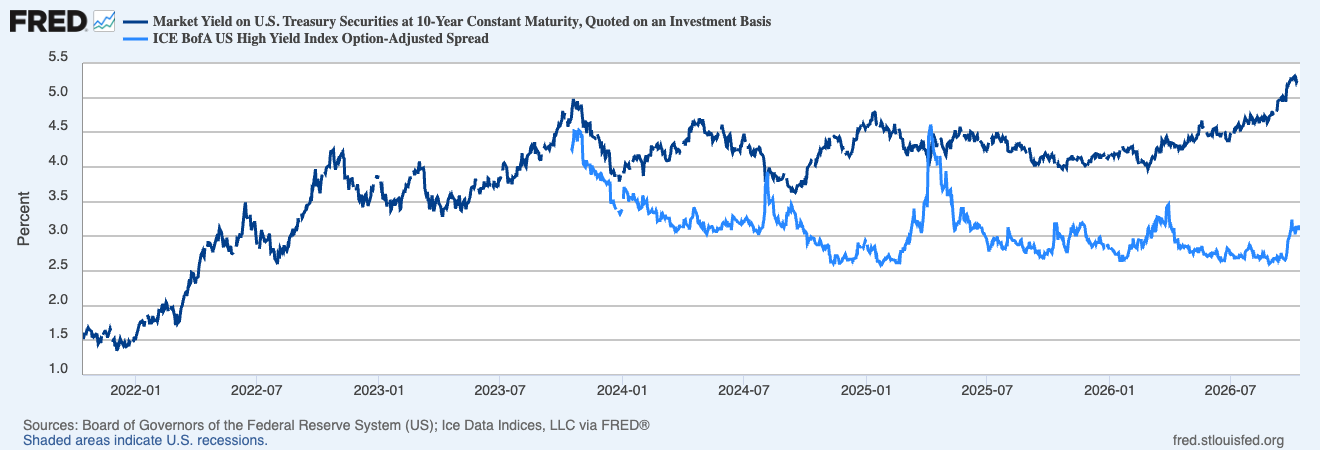
The dark line is the 10-year Treasury yield, now around 5.2%, its highest level in the five years shown here. The light line is the high-yield bond spread, the extra yield investors demand to lend to riskier companies instead of the U.S. government. It has widened to around 315 basis points, up from about 260 in September.
When safe yields rise, borrowing costs more and stocks priced on future growth tend to take the hit first. That's part of why chip stocks have slid even on strong earnings, and why consumer discretionary names have felt the squeeze.
My takeaway: Interest rates quietly shape almost everything in my margins this week: what companies earn, what they're worth, and how much consumers are willing to spend.
Two stories this week had the same plot twist. Delta posted record revenue and still cut its profit forecast, and ASML posted a huge quarter and still saw its stock fall. In both cases, what mattered wasn't the number everyone saw first. It was what the company said about what comes next, and what interest rates were doing in the background.
So the next time you see a company "beat" or "miss," try asking one extra question: what did they say about the future? It's usually where the real story is.
Now a question for you: what's one headline from this week you wish someone would explain?
That's all for this week's margin notes! Thanks for reading. Next week: United reports, and I'm excited to see if it tells the same fuel story as Delta, plus the WNBA Finals heating up.
Enjoy your Friday and a great weekend. See you next Thursday.
- Megan