Week 3: October 22, 2026
Welcome back! This week, four big companies reported earnings, and each topped Wall Street's expectations on at least one headline number. So why did one stock climb, one barely moved, and two dropped? Let's get into it!
Same "Beat", Different Reaction
As we discussed last week, when a company beats earnings, you'd expect the stock to go up. This week was a reminder that it doesn't work that way. Here's the scorecard.
Meta (META): the winner. Revenue jumped 26% to $64.6B, beating the $63.4B analysts expected. Meta's stock rose after the report to $694.25 in after-hours trading, but slipped to around $682 in Thursday's premarket as some of that jump faded. Now look at the headline earnings per share (EPS), which is $3.83. That looks like a miss, but it includes a $9.89B legal charge tied to a settlement with 52 state attorneys over teen mental health, and without it, EPS would have been $7.40. The other thing investors had to swallow: Meta expects to spend between $135B and $145B on capital expenditures like data center infrastructure. That's a lot of AI spending, but investors seemed willing to accept it alongside 26% growth.
Tesla (TSLA): the shrug. Adjusted EPS, which doesn't take into account one-time items, was $0.48 against the $0.45 expected, on revenue of $28.05B. But operating income fell 56% as spending on AI and its Optimus robot climbed. Tesla climbed 3.41% to close at $386.47 before the report, then slid to about $372.70 in premarket trading. A good sign that some of the good news was already priced in. Some of the good news may have been "priced in" before the numbers even came out.
GM and Netflix: the droppers. GM beat modestly and announced a $20B stock buyback, meaning the company will buy back its own shares, yet the stock fell nearly 2% on Tuesday to $76.11. The reason was the outlook: companies give investors a forecast for the full year, called guidance, and it's usually a range. Its profit forecast went from a range of $12.00 to $14.00 per share to $12.75 to $13.75, a narrower range with the same middle. Investors were hoping for a higher forecast, and a tighter range with the same middle isn't one. Netflix beat too, with EPS of $0.87 versus $0.82 expected and revenue up 11.9% to $12.87B, but the stock dropped about 5.8% to $65.04.
So what's going on? Two things. First, the bar is high. Wall Street expects S&P 500 earnings growth of around 29.6%, per FactSet, so a small beat is the minimum, not a surprise. Second, "priced in": a stock's price already reflects what investors hope will happen, so the move depends on whether the news is better than hoped, not just better than expected. This is the same pattern we saw with Constellation and ASML.
My takeaway: Beat or miss is only the first line of the story. What the company says about the future, how it's spending, and what investors already expected tell you much more. Next time you see a stock fall on good news, ask: what was already priced in?
- ✈️ United just confirmed what Delta told us. Remember last week's fuel story? United's up next, and it's the same plot. It cut its 2026 profit forecast to just $0.50 to $1.50 a share, down from $9 to $11 back in July. That's a huge drop. The culprit is fuel, with United's fuel bill up about 62% to $4.84 billion, and it expects to pay around $4.80 a gallon in the fourth quarter, up from $3.90 in the third. The good news for the airline: people are still flying, with passenger counts up more than 2% from last year.
- Why it matters: When two of the biggest airlines tell the same story, it's not one company having a bad quarter, it's an industry-wide cost squeeze. Travelers are still booking, but they're paying higher fares to do it.
- 🤖 Big Tech is spending an unreal amount on AI. Meta's report put a spotlight on it. The company narrowed its 2026 capital spending plan to $135 billion to $145 billion. And it's not alone: tech infrastructure spending is expected to hit about $790 billion in 2026, nearly double last year, and $1.2 trillion in 2027. That's close to $2 trillion in just two years.
- Why it matters: This is why every Big Tech earnings report now comes with one big question: is all this spending going to pay off? Microsoft, Alphabet, and Amazon report next week, so expect it to come up again.
- 🏀 The WNBA Finals are tied up. The Valkyries took Game 1 at home, 68-64, and the Dream bounced back in Game 2 with a 79-65 win. On Wednesday night, the Dream took Game 3 with a dramatic 97-71 win. Game 4 is Saturday at 1 p.m. ET, so there's still plenty of basketball left.
- Why it matters: Big Finals crowds and TV ratings are what bring in sponsors and media money, which is a big part of why women's sports are such a fast-growing business right now.
Why is flying getting more expensive?
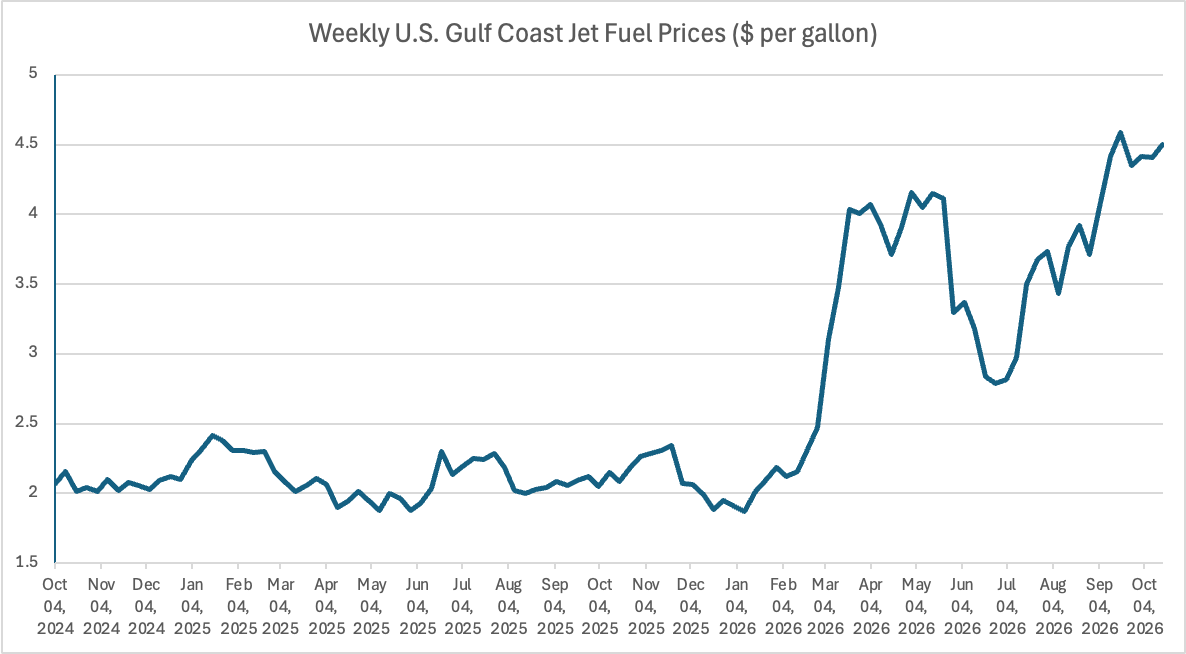
This chart tracks the weekly price of jet fuel on the U.S. Gulf Coast, in dollars per gallon. Through most of 2025, it hovered around $2. Then it jumped in March, and it's been volatile since: it dipped over the summer, then climbed again to a peak of $4.58 in September. As of the week ending October 16th, it's about $4.50 a gallon, more than double where it was a year ago.
That's a big deal for airlines, because fuel is one of their highest costs. Delta's jet fuel costs rose about 60% in the quarter, adding $1.6B in expenses, and United's fuel bill rose about 62% to $4.84B. Both cut their profit forecasts as a result. When costs jump like this, airlines have a few options: raise fares, cut spending, or accept lower profits, and they've done some of each.
My takeaway: A price you never see on your ticket can change a company's whole outlook, and it can show up in what you pay to fly.
Don't read too much into one day.
This week was a good reminder that a stock's one-day move says as much about expectations as it does about results. Meta beat and rose. GM beat and fell. Tesla beat and barely budged. If you're investing for the long term, a single day's reaction rarely matters. What matters is whether the businesses you own are getting stronger over time, and whether you're sticking to your plan instead of reacting to every headline.
That's a wrap on this week's margin notes! Thanks for reading. If you liked this issue, forward it to a friend who's curious about the markets.
Next week is a big one for earnings: Microsoft and Alphabet report on October 28th, and Amazon and Intel follow on October 29th. I'll be watching how much they're spending on AI and whether investors like what they hear. Enjoy your Friday and a great weekend! See you next Thursday.
- Megan